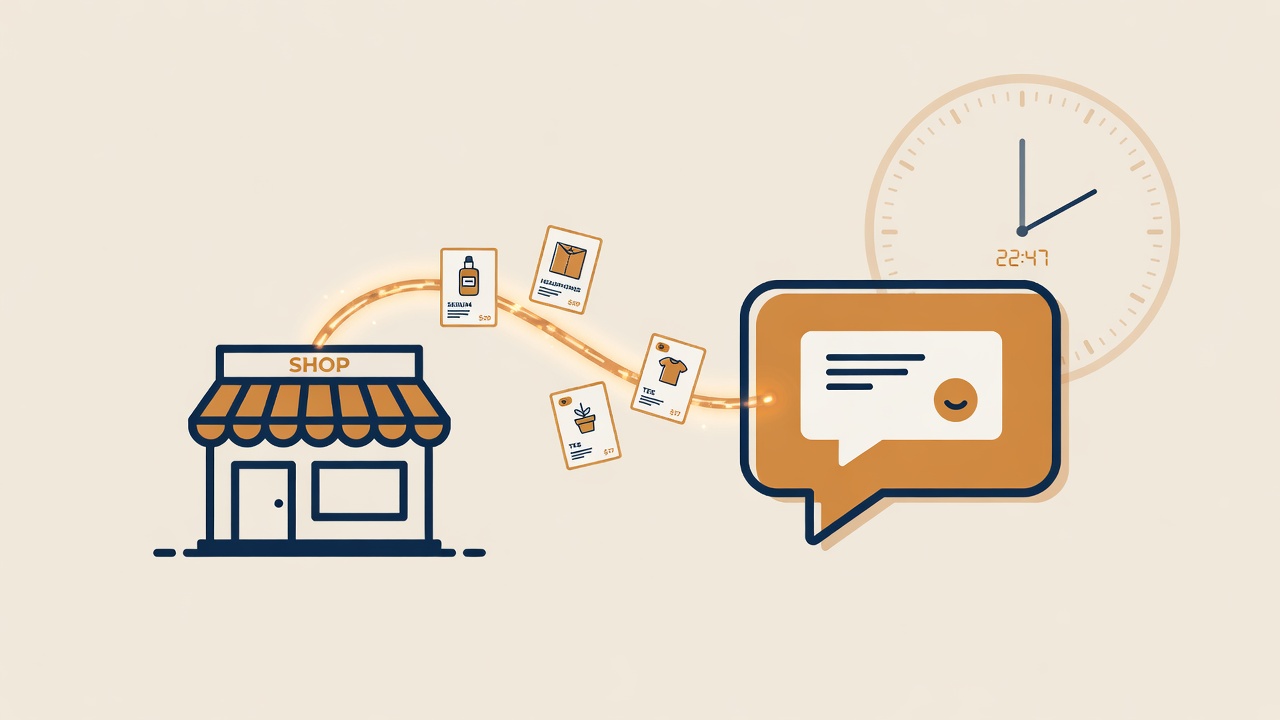
A story about two stores
Picture two furniture shops. Same products. Same prices. Same photos. Same Google ads pulling in a thousand visitors a day.
Store A has a beautiful website, a Contact us page, and an email address. Store B has all of that, plus a small chat icon in the bottom-right corner.
At 10:47 on a Tuesday night, Anna is browsing Store A. She wants a beige linen sofa. She sees one she likes, but the photo is a bit dark and she's not sure if it's cream or actual beige. She also wonders whether it fits through her apartment door — it's 74 centimetres wide and the sofa box dimensions aren't listed.
She scrolls. She looks for chat. Nothing. She clicks Contact us. She sees a form with six fields. She sighs. She'll email them tomorrow, maybe. She closes the tab.
At 10:47 on the same Tuesday, Olga is looking at the exact same sofa in Store B. Same doubts. She clicks the chat icon.
— Hi! Can I ask something about the Milo sofa?
— Of course, what would you like to know?
— Is it cream or beige in person? And what are the box dimensions for delivery?
— Cream — here is a daylight photo from a customer. Box size 185×72×68 cm, should fit through a standard 80 cm door. If your door is narrower, the legs unscrew and it drops to 64 cm.
— Perfect. I'll take it.
Two stores. Same sofa. One of them just sold it. The other one will never know Anna existed.
That is what a chatbot does. It is not magic. It is not "AI changing the world". It is removing the five-minute gap between a question and an answer — the gap where 96% of your visitors leave forever.
Why e-commerce is the worst place to have no chat
Think about the last time you bought something online that cost more than fifty euros.
You probably had questions. Not one — several. Does this pan fit on an induction stove? Will this jacket actually be warm in minus ten? Can I return it if the colour is off? When will it arrive?
You either got answers quickly and bought, or you didn't and you closed the tab. There is no third option. Nobody remembers to come back to a shop tomorrow to ask a question. Life moves on. Another brand. Another tab. Another checkout.
For content websites this gap costs you a newsletter subscriber. For e-commerce it costs you the sale itself. A real transaction. Real money. Every hesitation in the buyer's head is a visible crack in your conversion rate.
Every online store knows the numbers:
- Around 70% of carts are abandoned. That is the industry standard, same for Shopify stores, WooCommerce shops, and everyone in between.
- Around 40% of those abandonments are driven by unanswered questions — shipping, sizing, fit, delivery time, returns policy. Baymard Institute has been running that stat for a decade. It hasn't moved.
- Around 73% of online shopping happens outside of business hours. Evenings and weekends. When your support team is off.
Put those together and you get the real picture. Most of your buyers have questions. Most of them are asking when you are asleep. And most of them don't get answers — so they don't buy.
A chatbot does not solve everything. It solves this specific, very expensive, very fixable thing.
What an AI chatbot actually does in a shop (no magic)
Let me describe it the way a cashier describes their job.
When a visitor opens your store, the chatbot is a little icon in the corner. It doesn't shout. It doesn't pop up in their face with "We noticed you've been here for 30 seconds". It just sits there.
When the visitor clicks it, three things happen:
1. It answers questions about products.
The bot is connected to your catalogue. Not in some abstract way — it actually searches your products in real time. When a visitor asks "do you have a leather armchair under 500 euros", the bot queries your store's API the same way a staff member would check the system, and replies with the actual matches. With photos. With prices. With the Add to cart link.
If you're on Shopify, it talks to Shopify's API. If you're on WooCommerce, it talks to WooCommerce's API. The visitor sees results that are as fresh as the store itself — not a trained answer from a month ago.
2. It handles the stuff nobody wants to read.
Delivery time. Return policy. Payment methods. Warranty. "Do you ship to Finland?" "Can I pay in cash on delivery?" "How long does a return take?" Every shop has a FAQ page. Nobody reads it. A bot that knows the answers and can say them in one sentence is worth more than a 30-paragraph FAQ nobody will ever scroll.
3. It catches the people who are about to leave.
A visitor spends five minutes on a product page, adds to cart, goes to checkout, sees the delivery cost, frowns, closes the tab. The bot can notice that hesitation at checkout and say one line: "Hi, if the delivery cost looks high, we have free delivery on orders over 80 euros — want me to show similar items to add?". That one line recovers a percentage of carts that would otherwise just die.
That's it. It's not rocket science. It's a staff member who works every hour, speaks every language of your customers, and knows your entire catalogue by heart.
The moment people realise they needed one
Every shop owner has this moment. It happens a few weeks after they install the chatbot, when they open the conversation log for the first time.
They see a message at 23:14 from someone asking about a product. They see a message at 06:20 from someone in Finland asking about shipping. They see a message at 14:30 in Russian — a language the owner doesn't speak — from someone asking whether the bed frame comes with slats.
And the bot answered. All three of them. In their language. With the right information. At the right time.
The owner then thinks: "Wait. If the bot hadn't been there, I would have lost all three of these people. I didn't even know they existed."
That is the quiet horror of running an online shop without a chatbot. You do not see the visitors you lose. They don't send you an angry email saying "I wanted to buy your sofa but you weren't online". They just close the tab and go to your competitor. The loss is invisible. The bot turns that invisible loss into visible conversations — and many of those conversations turn into orders.
"But what about real human support?"
Good question. People still want to speak to humans for complicated things — refunds going wrong, custom orders, complaints. A bot should not replace that. A bot should filter the boring stuff so that your humans get to handle the interesting stuff.
In a typical small shop, 80% of incoming questions are repetitive:
- "Is this in stock?"
- "How much is delivery?"
- "What size should I take?"
- "When will my order arrive?"
- "Do you have this in blue?"
A bot handles all of them in seconds. The remaining 20% — real complaints, complex custom requests, angry customers — get passed to a human. Ideally via Telegram. The bot sends you a message, you reply when you can, the customer gets a human reply. Nobody is left hanging, nothing gets lost, and you're not burning two hours a day on "yes it's in stock".
Shop owners who tried to respond manually will tell you: the second you add a bot, you sleep better. Not because the bot is smart. Because it is consistent. It doesn't miss messages. It doesn't get tired. It doesn't confuse one customer with another.
What about the language thing
Let's talk about Estonia specifically, because that's our backyard.
An Estonian webshop typically has customers who write in Estonian, Russian, English, and Finnish. Sometimes German. The shop owner speaks two of these fluently, maybe. What do you do when a Finnish tourist buys a souvenir online and writes to you in Finnish about shipping to Helsinki?
Option A: you Google Translate your way through the conversation, reply in broken Finnish, feel awkward, and get a reply that's also partially wrong because of the translation. Time: 10 minutes. Confidence: 40%.
Option B: you ignore them until tomorrow when you can ask your Finnish-speaking friend for help. Meanwhile they have ordered from a Finnish shop and they're gone.
Option C: the bot reads the Finnish message, understands it, checks your shipping settings, replies in perfect Finnish within two seconds. "Kyllä, toimitamme Helsinkiin, kesto 2-3 päivää, hinta 8 €." Done. Customer delighted. Order placed.
The third option is not a dream. It is literally how MyChat works today. The AI behind it speaks twelve languages natively, detects them automatically, and replies in the same language. You don't configure anything. You don't have to speak Finnish. The bot does.
If you sell in a multilingual region — Estonia, Switzerland, Belgium, Canada, honestly most of Europe — this one feature pays for the whole thing.
The difference between a dumb bot and a real one
A few years ago, chatbots were terrible. They were scripts. If you said "Is the red sofa in stock?", they would match the word "stock" and reply with "Our stock is delivered weekly from our warehouse", because that's what someone programmed them to say. You said "no, I asked about a specific product", and they said "Our stock is delivered weekly from our warehouse". Visitors hated them. Shop owners hated them.
AI chatbots built on modern language models — the kind that runs behind MyChat — are a different species. They read what the customer wrote, they understand what the question actually is, and they use real data from your store to answer. They can tell you "Yes, the red Milo sofa is in stock, three pieces left in the Tallinn warehouse, delivery 2 days, price 499 euros" because they just asked your Shopify or WooCommerce database.
If your experience of chatbots is from 2019, please try one now. It's a completely different product. The jump in quality is the same as going from GPS that constantly recalculates to one that actually knows where you are.
"Okay, but does this actually make money?"
Let me do the math in front of you.
A small online shop with 200 visitors a day. Average order value: 85 euros. Conversion rate without chatbot: 1.8%. So: 200 × 0.018 × 85 = 306 euros per day. Or 9,180 per month. Or 110,160 per year.
Now add a chatbot. Industry benchmarks say a good chatbot increases conversion by somewhere between 10% and 30%. Let's be conservative and say 15%. New conversion: 2.07%. Same traffic. New revenue: 200 × 0.0207 × 85 = 352 euros per day. That's 46 euros more. Every day. Over a year: 16,790 euros extra.
The bot costs you 69 euros a month — so 828 euros per year. The return is roughly 20 times what you pay for it. And that's with the conservative 15% lift.
The shops that have been running a bot for over six months typically tell us the real lift is 20-25%. At 25%, the extra revenue is 27,500 euros per year on the same traffic. The bot pays for itself in the first two days of the first month. Everything after that is profit.
This is not hype. It's just numbers. A shop that doesn't have a chatbot is letting money walk out the door because of questions that take three seconds to answer.
What makes a chatbot actually good for an online store
Not all bots are equal. Some are form-wizards pretending to be chat. Some are trained on your website text and nothing else, so they can't tell you prices. Some speak like a customer support script from 2015. Here is what separates a real commerce bot from a toy:
It reads your catalogue live, not once. When you add a new product or mark something out of stock, the bot knows immediately. No training. No retraining. No "please update the bot once a week". It queries your Shopify or WooCommerce API when the visitor asks, and returns fresh data every time.
It shows products, not paragraphs. When the bot says "here are three options", it shows three actual cards with photos, prices, and an Add to cart button. Not a wall of text. Visitors click directly.
It handles pictures. A customer sends a photo of a chair they like from somewhere else: "do you have something like this?". The bot sees the photo, searches your catalogue for similar items, and shows what you actually sell. This sounds like science fiction. It works today.
It handles voice. Many customers on mobile — especially outside the US — prefer to send voice messages. A bot that transcribes and understands voice gets a completely different kind of customer.
It respects the visitor. It doesn't pop up 3 seconds after they land on the page. It doesn't chase them across sections. It sits quietly, and greets them only when their behaviour (long time on product page, returning to cart twice) suggests they could use help.
It hands off to humans cleanly. When the bot doesn't know, it doesn't hallucinate. It says "I'm not sure about this one — the team will get back to you" and collects contact info. You get a Telegram notification. You reply when you're free. No customer is stuck in a loop.
A bot that does these six things replaces a part-time support person and never takes a day off.
Objections shop owners always have (and answers)
"My customers prefer to email."
Test this. Add a chat bubble on a Tuesday. On Wednesday look at the log. You will see more conversations than you expected. Humans go to the lowest-friction channel available. If chat is there, they use chat. If only email is there, they use email — or they don't bother. Most shop owners are shocked by how much demand for chat was there, hidden, before they installed it.
"My products are too complex for a bot."
The bot isn't selling a specialist medical device. It's helping someone choose between a small and a medium. Ninety percent of e-commerce conversations are the same five questions. The bot handles them in seconds. For the 10% of genuinely complex cases, it passes to you.
"I tried one years ago, it was rubbish."
So was a smartphone in 2007. Try one now.
"AI makes mistakes."
It does, occasionally. So does a tired employee at 8 PM. A modern AI chatbot linked to your catalogue makes fewer mistakes than a junior staff member on their second shift. And when it's unsure, it says so — and hands off to you. The risk is smaller than the risk of a human moment.
"It's expensive."
39 euros a month for a website plan. 69 euros a month for a full e-commerce integration. Less than one lost order pays for it.
How to get started in one evening
This is the unsexy, practical part.
- Pick a platform. MyChat works out of the box with WordPress, Shopify, and any plain HTML site.
- Create an account. 30 seconds.
- Paste your store URL. The AI reads your pages, your product descriptions, your shipping info, your FAQ — and automatically writes a system prompt that describes your brand voice.
- Connect your catalogue. For Shopify: create a custom app in your admin, copy an access token, paste it in MyChat. Takes three minutes. For WooCommerce: paste your REST API keys. Same time.
- Embed the widget. One script tag, before the closing